
Goals
Wave of Campaigns
Time period
Country
Location City/State/Province
Location Description
Methods in 1st segment
Methods in 2nd segment
- Graduate instructors and teaching assistants refuse to turn in fall grades.
Methods in 3rd segment
Methods in 4th segment
- Organizers from UC campuses founded Strike University, a digital initiative to provide accessible and free public education.
Methods in 5th segment
Methods in 6th segment
Additional methods (Timing Unknown)
Segment Length
Leaders
Partners
External allies
Nonviolent responses of opponent
University of California, Santa Cruz administration fired around 80 graduate student instructors and teaching assistants.
Opponents
Repressive Violence
Cluster
Classification
Group characterization
Groups in 1st Segment
Groups in 2nd Segment
Groups in 3rd Segment
Groups in 5th Segment
Segment Length
Success in achieving specific demands/goals
Survival
Growth
Total points
Notes on outcomes
Survival and Growth: The campaign gained widespread support from UC campuses and across the country, continuing even during the COVID-19 pandemic. However, the pandemic did impact the campaign's growth and survival, with most of its supporters coming from UC campuses.
Database Narrative
Santa Cruz, California, situated in the northern part of Monterey Bay, is home to the University of California, Santa Cruz (UCSC). While Santa Cruz has been known for its natural beauty and popular tourist attractions, it has also long been ranked among the most expensive in its housing rent since 2023. Such towering rent was experienced by the graduate students of UCSC, who frequently had to spend up to 60% of their wages on rent, becoming “severely rent-burdened.” Dissatisfied with the lack of cost-of-living adjustment (COLA) in the previously signed collective bargaining agreement between the University of California system and United Auto Workers Local 2865, and in the face of the constantly rising cost of rent in Santa Cruz, graduate students initiated a series of strikes against the University. They engaged in picketing, protest meetings, and sit-ins, urging the UCSC administration to address the burdensome cost-of-living students experienced. This campaign began in September 2019, when UC Santa Cruz Graduate Student Association (GSA), UAW2965, and campus supporters collectively demanded a Cost of Living Adjustment across campus.
On 7 November 2019, the UC Santa Cruz GSA Executive Board delivered a clearly outlined list of demands to Chancellor Cynthia Larive and Campus Provost and Executive Vice Chancellor Lori Kletzer. With UAW2965 and graduate student supporters on campus, the GSA executive board demanded “an ongoing payment to every graduate student that would bring us out of rent burden and to wage parity with graduate students at UC Riverside. At current rates, this amounts to $1,412 per month.” In addition, the executive board stressed that this Cost of Living Adjustment should apply to every graduate student regardless of their residence or visa status.. Simultaneously, they demanded that the adjustment should be made by the UC Santa Cruz administration (1) “without raising tuition or campus fees” and (2) “with a guarantee of non-retaliation.” Two hundred graduate students marched to Kerr Hall, UCSC’s primary administration building, to deliver the demands verbally and in writing.
Tensions between the graduate students and administration continued to escalate throughout November and peaked on 5 December 2019, when Executive Vice Chancellor Lori Kletzer responded to a student email requesting administration action on COLA by directing the student to a copy of the student conduct handbook and cc’ing the entire graduate student body.
Infuriated by this intimidation attempt by the Executive Vice Chancellor, graduate students circulated a strike poll. On 7 December 2019, UCSC faculty joined the effort and petitioned in support of COLA. A day later, graduate teaching assistants (TA) began a “grading strike”. More than 250 graduate students attended an assembly meeting to organize the strike, and at least 80 graduate instructors and teaching assistants agreed to withhold fall semester final grades.
9 December 2019, marked the start of the wildcat strike. Over 200 students and faculty gathered in front of McHenry Library in a rally. Over the following month, a series of protests took place on the UCSC campus, and GSA continued to pressure the administration to engage with their listed demands. Similar actions had emerged across other University of California campuses, such as UC Berkeley and UC Los Angeles. On 9 January 2020, graduate students and other supporters of COLA met in a general meeting to discuss and strategize possible escalatory actions. Around 200 graduate students voted in favor of strike escalation.
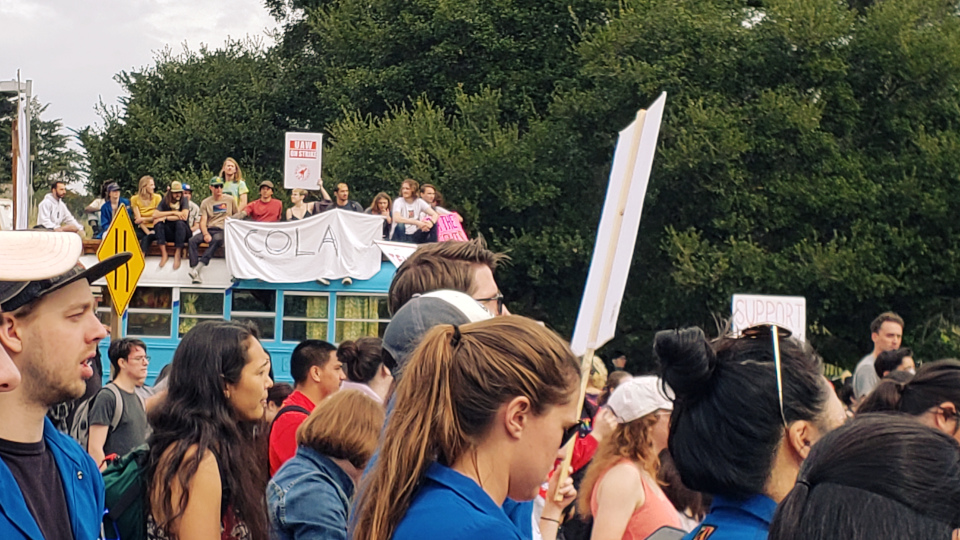
(Photo credit: hinnk [CC BY-SA 3.0

(https://creativecommons.org/licenses/by-sa/3.0)]
Over the month and throughout these protests, the administration had indirectly and directly maintained its threats toward striking graduate students, claiming that students would be charged with “possible rules violations.” Nevertheless, graduate students consistently assembled and began to organize further actions. In a general assembly on 30 January, the majority voted to organize a full graduate student strike in February.
On 5 February, UCSC administration emailed a “Written Warning for Withholding Undergraduate Student Grades” in response to the grading strike. In this letter, the administration characterized the strike as student conduct code misconduct regarding teaching assistant responsibilities, outlining potential consequences.
Five days later, on 10 February, hundreds of students, faculty members, and supporters gathered near the West entrance of campus and rallied for COLA, marking the start of a full-scale teaching strike. In response to the strike, University administrators called the University of California Police Department and California Highway Patrol. Protesters engaged in picketing, public speeches, button-making, and music and dance performances.
The next day, administrators Lori Kletzer and Quentin Williams met with three graduate students and two faculty members, the administrators offered to meet with the students to discuss students’ financial resources if the protesters end the strike. No agreement was reached between the protesters and administrators, and the GSA decided that the administration’s offer of “substantive meetings” was not sufficient to call off the strike.
On 12 February, the police department violently arrested 16 peaceful student protesters, pressing them onto the ground and tying their hands with plastic bands. Two days later, in a letter, University of California system President Janet Napolitano publicly criticized the wildcat strike and threatened that “participation in the wildcat strike will have consequences.” The UC Academic Council, UCSC faculty members, and students from other campuses urged Napolitano not to retaliate against student protesters.
The GSA, graduate members, and faculty in solidarity continued organizing strikes, picketing, and sit-ins across the UCSC campus. On 19 February, faculty senates passed two resolutions in support of COLA. One resolution called for the removal of university survey data on faculty, and the other resolution called for a rise in graduate students’ wages. The latter insisted on dismissing any disciplinary action against the protestors. On the 28th, the university fired around 80 teaching assistants on the grounds that their withholding of student grades violated the university’s student conduct policy.
In response to the emergence of COVID-19, UCSC suspended in-person activities on 10 March 2020. Student protests moved to digital picketing and strike actions. On 30 March 2020, GSA, alongside some other organizers from six other UC campuses, founded Strike University, a digital initiative to provide accessible and free public education. The online university served as a space in which the organizers and protesters reimagined a “non-hierarchical” education system. Meant to foster intercampus solidarity, this digital initiative celebrated “shared dialogue, strategy, training, and learning for COLA and many other fights against the UC and the academic industrial complex.”
On 1 May, a UC-wide strike took place. Strikers organized slow-moving protests in caravans of cars and bicycles to honor those who are fighting and striking across the different UC campuses. The slow-moving strike urged all protesters to withhold any forms of labor from the UC, disrupting the Universities’ general operations. In July, UCSC administration and UAW 2865 settled on an agreement that promised the University’s reinstatement of 41 graduate students in exchange for having UAW 2865 drop their unfair labor practice charge against the university. The administration reinstated the students in August, and the university promised no further disciplinary sanctions against student protestors.
Although the university did not meet the specific demands for the ongoing payment outlined in COLA, the UCSC administration offered two supplemental programs: a $2,500 need-based housing fellowship every year and a housing assistance program. Nevertheless, in response to this outcome, student protesters declared that the housing programs were not enough. The administration claimed that they would discuss potential wage raises and better working conditions for graduate students moving forward.
Influences
University of California, Santa Cruz's graduate students wildcat strike inspired other similar strikes calling for cost-of-living adjustments on California campuses. (2)
Sources
Anon. n.d. “FAQ: Graduate Student Strikers.” Making Sense of the Current Campus Climate. Retrieved October 9, 2024 (https://campus-climate.ucsc.edu/campus-impacts/graduate-student-strikers/).
Burke, Lilah. n.d. “UC Santa Cruz Reinstates 41 Fired Grad Students.” Inside Higher Ed, August 11. Retrieved October 8, 2024 (https://www.insidehighered.com/quicktakes/2020/08/12/uc-santa-cruz-reinstates-41-fired-grad-students).
Cowan, Jill. 2020. “Why Graduate Students at U.C. Santa Cruz Are Striking.” The New York Times, February 11. Retrieved October 8, 2024 (https://www.nytimes.com/2020/02/11/us/ucsc-strike.html).
Ho, Vivian. 2020. “UC Santa Cruz Fires 54 Graduate Students Participating in Months-Long Strike.” The Guardian, February 28. Retrieved October 8, 2024 (https://www.theguardian.com/us-news/2020/feb/28/university-of-california-student-strike-fired).
UC Santa Cruz Graduate Students Association. n.d. “Wildcat Campaign Timeline.” Pay Us More Ucsc. Retrieved October 9, 2024 (https://payusmoreucsc.com/wildcat-campaign-timeline/).