
Goals
Time period
Country
Location City/State/Province
Location Description
Methods in 1st segment
Methods in 2nd segment
Methods in 3rd segment
Methods in 4th segment
- The organizers and educators held non-disruptive "walk-ins," which is more of a gathering that discusses plan and strategies to mobilize.
Methods in 5th segment
- The organizers and educators held non-disruptive "walk-ins," which is more of a gathering that discusses plan and strategies to mobilize.
Methods in 6th segment
Additional methods (Timing Unknown)
Segment Length
Leaders
Partners
Opponents
Arizona State Legislature
Cluster
Classification
Group characterization
Groups in 1st Segment
Groups in 4th Segment
Segment Length
Success in achieving specific demands/goals
Survival
Growth
Total points
Notes on outcomes
Survival Growth: The campaign grew significantly over its timeline and managed to survive with great impacts until their demand(s) were addressed.
Database Narrative
Arizona, a southwestern U.S. state known for its diverse geography and iconic landmarks, had approximately 48,510 teachers in its public schools in 2018. For three decades, under state budget and education fund cuts, teachers' salaries were between $8,000 and $9,000 lower than teachers' salaries had been in 1990. According to the state's auditor general, Arizona teachers' wages averaged $48,372 per year in 2018, ranked among some of the lowest in the nation. Simultaneously, the growth of privatized education in Arizona led to further unemployment and wage decreases for teachers. Inspired by the West Virginia teachers and school staff strike earlier in the same year, more than 50,000 protesters in over 1,000 schools across Arizona joined together for a series of walkouts and nonviolent actions, known as the #RedforEd campaign.
Arizona's #RedforEd campaign started over the first weekend of March (3-4 March) in 2018, with a group of teachers coming together on social media and creating Arizona Educators United, a facebook group that later developed into a coalition. In a few days, this private Facebook group grew to more than 24,000 members and, at its peak, boasted 49,000 members. According to Noah Karvelis (one of the organizers), the organizer group was composed of educators with little to no knowledge of political organizing. Using the Facebook page, they urged educators and those who support education to wear red on Wednesday, 7 March, in support of the campaign's attempt to raise awareness of the low wages and funding cuts that prevented public schools from paying existing educators appropriately and hiring talented instructors.
The campaign had five established demands of the Arizona State Government: (1) a 20 percent salary increase, (2) a restoration of education funding to 2008 levels (adding about $1 billion more in state funding to education), (3) competitive pay for all education support staff, (4) permanent salaries for teachers including annual raises, and (5) no new tax cuts.
On 7 March, thousands of educators and supporters across Arizona wore red to schools and.photos of themselves using the hashtag #RedForEd. However, the hashtag action was only one of the nonviolent methods that educators and supporters used. In the following two weeks, they engaged in more direct action, including peaceful protests and labor strikes. On 12 March, around 300 teachers, many from Arizona Educator United, which was now classified as a grassroots organization, demonstrated outside the Phoenix radio station, where Arizona's Governor, Doug Ducey, was being interviewed. Two days later, hundreds of educators demonstrated at the state Capitol, involving bannering, chanting, assemblies, and other nonviolent actions. On 20 and 21 March, educators in the Pendergast Elementary School District organized a couple of sick-outs that resulted in hundreds of teachers calling in sick and not showing up to work. The series of sick-out protests eventually forced nine schools in the West Valley into closure on 21 March.
Over the next few weeks, educators from other school districts joined the campaign. Hundreds of teachers in the Chandler Unified School District, one of Arizona's largest districts, marched peacefully in support of the movement. The district held two rally sessions, with each amounting to 1,600 educators and school employees. Similarly, hundreds of educators in the Peoria Unified School District protested at the state Capitol against the education funding cut. On 28 March, about 2,500 educators and their supporters marched at the state Capitol. In an open response, Governor Ducey acknowledged the importance of Arizona educators and promised that the state government would do more in the future.
However, contrary to his optimistic message, on 10 April, in a KTAR radio interview, Governor Ducey called the protests a "political circus." The next day, over 100,000 educators and supporters in 1,112 schools across the state's 130 school districts participated in a statewide non-disruptive "walk-in." Thousands of Arizona teachers, students and parents gathered in front of their schools and shared signs, snacks, and also their concerns over the legislature that had caused the funding to drop. The activists meant to build awareness and garner support for a later statewide walkout, and they did not intend to interfere with normal school operations. Two days after the statewide walk-in, Governor Ducey proposed a 20 percent raise by 2020 for teachers in Arizona, starting with a 9 percent hike next year. However, the organizers criticized the plan as insufficient to meet their demands.
On the week of 15 April, in the hope of further escalating the campaign to pressure the legislature, organizers launched a statewide poll in their Facebook group for educators and school administrators to vote on whether to hold a statewide walkout. Approximately 57,000 educators and school staff voted in favor of the walkout. Moreover, around 30 district school boards publicly supported the action. The organizers scheduled the statewide walkout for 26 April.
Between 23 and 25 April, three days before their official walkout, #RedForEd organizers launched a serioes of three-day peaceful walk-ins. Similar to the previous walk-ins, the organizers meant these actions to facilitate discussions and rally support for the following actions.
Starting on 26 April, more than 1,000 schools closed due to educators walking out and not showing up to teach, and Arizona shut down its schools for six days. While some schools anticipated the closure, some had to respond to the strike quickly. At its peak, the walkout involved more than 50,000 protesters, impacting around 850,000 students in the 130 school districts. Throughout the six days, the protesters returned repeatedly to the state Capitol, pressured the legislature to discuss unresolved budget negotiations, and pushed for their demands. #RedForEd Protesters all wore red to the rally and held banners and chanted against the state-introduced education funding cuts and low pay.
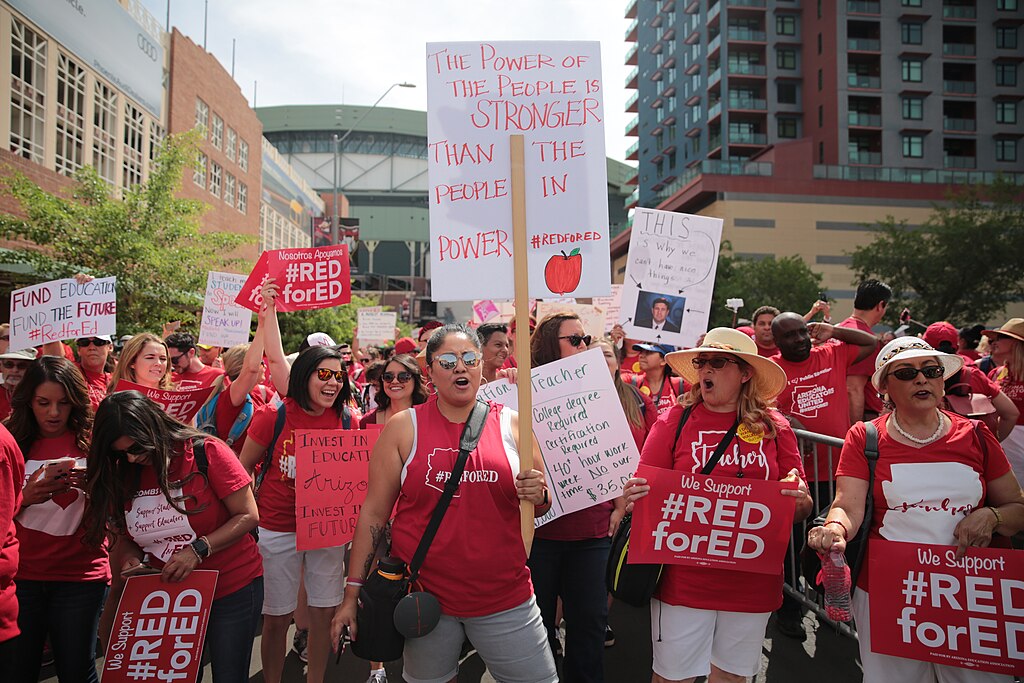
(Photo credit: Gage Skidmore for Arizona Education Association [CC BY-SA 2.0]

(https://creativecommons.org/licenses/by-sa/2.0)]
On 3 May, The Arizona Legislature passed a state budget that anticipated salary increases for teachers with a total of $273 million, a 19% increase if equally distributed. Later that day, Governor Ducey signed the bill into effect. However, while some protesters celebrated their overall success, others underscored how the distribution of the increased budget fell to decision making in each individual district. This meant that the 19% wage increase did not equate to the protestors’ demand of an “equally distributed” 20% increase for all teachers and the bill hardly mentioned other demands.
Influences
This campaign was inspired by the success of the West Virginian teachers strike for better pay and insurance earlier this year (1).
Sources
Associated Press. 2018. “Striking Arizona Teachers Win 19% Raise, End Walkout.” Los Angeles Times, May 3. Retrieved November 13, 2024. (https://www.latimes.com/nation/nationnow/la-na-arizona-teachers-20180503-story.html).
Cano, Ricardo. 2018. “Teachers behind #RedForEd Protest ‘in Awe’ of Support, Plot next Moves.” The Arizona Republic, March 8. Retrieved November 13, 2024. (https://www.azcentral.com/story/news/local/arizona-education/2018/03/08/teachers-behind-redfored-protest-awe-support-plot-next-moves/401527002/).
Gonzales, Richard. 2018. “Arizona Teachers Vote to Strike, Sparking Statewide Walkout.” NPR, April 20. Retrieved November 13, 2024. (https://www.npr.org/sections/thetwo-way/2018/04/20/604185559/arizona-teachers-vote-to-strike-sparking-first-ever-statewide-walkout).
Kuhn, Casey. 2018. “Arizona Teachers ‘walk-in’ to Protest Low Pay and Low Funding.” NPR, April 11. Retrieved November 13, 2024.(https://www.npr.org/2018/04/11/601419914/arizona-teachers-to-protest-low-pay-and-school-funding-shortfalls).
Ricardo Cano, Anne Ryman and Lily Altavena. 2018. “Arizona Teachers Will Walk out Again Thursday as Budget Votes Drag On.” The Arizona Republic, May 2. Retrieved November 13, 2024. (https://www.azcentral.com/story/news/local/arizona-education/2018/05/02/arizona-teacher-redfored-walkout-really-end-thursday-legislature-budget/574251002/).
Romero, Simon, Jack Healy, and Julie Turkewitz. 2018. “Teachers in Arizona and Colorado Walk Out Over Education Funding.” The New York Times, April 26. Retrieved November 13, 2024. (https://www.nytimes.com/2018/04/26/us/teacher-walkout-arizona-colorado.html).
staff, The Republic. 2019. “A Year after the Teacher Walkout, a Timeline of Arizona’s #RedforEd Movement.” The Arizona Republic, April 11. Retrieved November 13, 2024.(https://www.azcentral.com/story/news/local/arizona-education/2019/04/11/arizona-teacher-walkout-timeline-red-for-ed/3337757002/).